Tuesday, November 11, 2014

Illustrators with Ink: Lisa Congdon [feedly]


----
Illustrators with Ink: Lisa Congdon
// Brown Paper Bag

false
Lisa Congdon

Photo credit: Sarah Deragon.

It's another installment of Illustrators with Ink, which is quickly becoming one of my favorite features I've ever had on Brown Paper Bag. Today, let's take a look at illustrator Lisa Congdon's tattoos!

Lisa Congdon is a creative lady who probably needs no introduction. Her colorful work is featured in magazines, on wallpaper, textiles, and in different galleries around the United States. In addition, Lisa is also a blogger and published author! She definitely keeps herself busy, and I'm elated to share with you an interview with her about her ink.

How many tattoos do you have? 12
How old were you when you got your first tattoo? 29 (I am 46 now).
Did you design any yourself? If not, would you ever?No, I don't have any of my own design on my body, but I have designed many tattoos for other people. And I do have a plan to design something for myself soon.
Do you have a favorite? If so, which one and why? My favorite is probably my tattoo of my chihuahua, Wilfredo. He's my soul mate, my constant companion, my anxiety buffer. I love that he'll be with me forever, even after he dies.
Where did you get your work done? I have gotten tattoos by a few different people, but for the past eight years or so I have been going to Cicely Daniher at Cyclops Tattoo in the Mission District of San Francisco. She's the best, in my opinion.
Is there any meaning behind any of your tattoos? Any stories?I had a really difficult and traumatic life experience last year and during that time I got my tiger tattoo with the words Je suis fort — which means "I am strong" in French. Having a tiger on one arm and a chihuahua on the other keeps me protected.
Do you see a connection between the type of tattoos you have and your illustrative work?Most of my tattoos are visual symbols of things that I find beautiful or inspiring or significant, and so in that way they relate to my work, because my work is often about things I find beautiful, inspiring or significant (even difficult or sad things). But visually they are super different because I didn't design any of them.

lisa congdon

Photo credit: Sarah Deragon.

Photo credit: Sarah Deragon

Photo credit: Sarah Deragon

Photo credit: Sarah Deragon

Photo credit: Sarah Deragon

Photo credit: Sarah Deragon

Photo credit: Sarah Deragon

Photo credit: Sarah Deragon

Photo credit: Sarah Deragon

Photo credit: Sarah Deragon

Photo credit: Sarah Deragon

Photo credit: Sarah Deragon

Photo credit: Sarah Deragon

Photo credit: Sarah Deragon

Photo credit: Sarah Deragon

Thanks, Lisa!

And, here's some of her work:

lisa congdon

lisa-congdon-2 lisa-congdon-3 lisa-congdon-5lisa-congdon-6

The post Illustrators with Ink: Lisa Congdon appeared first on Brown Paper Bag.


----

Shared via my feedly reader


Sent from my iPad

Saturday, November 8, 2014

The Re-Cover Project [feedly]


----
The Re-Cover Project
// Muddy Colors

David Palumbo

I'm a big believer in the value of personal projects.  Though not every experiment or personal series which I've explored has lead to a lightbulb moment, every lightbulb moment I've experienced owed a great debt to the time which I had invested in personal projects.  I know for certain that I would not be the painter that I am without having set aside time for experimental work.

My most recent series that I'm particularly excited about is the Re-Cover Project.  Basically, I have been finding old hardcover copies of some of my favorite books and creating new cover images for them directly on the book itself.

The series started in an almost accidental way.  Some years back, a fellow artist (hey Bill!) was generous enough to send me a couple drawings of apes which I really liked but he refused to take any payment for them.  The best I could get in the way of reciprocating was he said, if I really felt like sending him something in return, I could send some books to read.  For the next two or three years I tried my best to collect a good group of books but really didn't know what he had already read or what his taste might be, so the books went unsent.  Finally, earlier this year, I knew we'd be seeing each other at SFAL and wanted to finally bring something after all of this time.  Looking back through the box, one of the books I'd set aside was a 1963 first American edition of Planet of the Apes.  Tying this to the ape drawings I'd been given, I thought it might be fun to paint an ape onto the book as a new cover.


It was one of those moments where I wasn't sure if this idea was good or terrible, but figured it might be a fun experiment so I ditched the dust jacket, gessoed up the front board, and jumped right in.

Like any experiment which turns itself into a series, I really enjoyed myself on that first one.  I had the end papers of N.C. Wyeth's treasure island in my mind as I worked and so ended up limiting myself to a similar palette of black and white with one "spot color".  The thing that I really enjoy about this limitation is how much it focuses my attention on design.

I began thinking up other books which might be fun to re-imagine.  I started reading books I'd always meant to read but had never found the time for, which meant I started making more time to read in general.


One of the wonderful things in a personal series is exploring processes or visual solutions which you would not turn to on a job.  It seems that is the sacrifice needed when appeasing the angry volcano gods called deadlines and client expectations.  Without those pressures, however, I've had fun pushing graphic ideas into places I normally might shy from.  It's too early to tell how this might filter in to my illustration work, but I'm certain that it is already having some effect.


Another thing about this series which has been really enjoyable for me is the conversations which it sparks with people when they see them.  People who know the stories will talk about the choice of cover image while people unfamiliar with the stories might be interested to finally pick it up.  Of course, that is besides the number of recommendations which I've been given for books I've yet to read (and so they are added to the ever growing list...)


The books are all vintage copies when I can manage it.  Some have been too rare for me to be able to use an actual first edition, but finding re-printings and book club editions from decades ago are just as good to me.


I think of each cover as a puzzle in a way, which is why these are shown mostly head on and without titles.  If you are curious to know what each book is, I'm listing the spoiler sheet at the end ;)


Books shown, from the top:


The Man in the High Castle by Philip K Dick (1962 book club edition)
Planet of the Apes by Pierre Boulle (1963 1st American edition)
The Right Stuff by Tom Wolfe (1979 1st edition, 2nd printing)
The Stars My Destination by Alfred Bester (2003, SFBC 50th Anniversary edition)
The Shadow of the Torturer by Gene Wolfe (1980 book club edition)
The Call of the Wild by Jack London (1931 reprint)
Casino Royale by Ian Flemming (1953 1st [?] edition)
The Hobbit by J.R.R. Tolkein (recent printing)
The Time Machine by H.G. Wells (1927 reprint)
The Great Escape by Paul Brickhill (1950 1st [?] edition)
The Shining by Stephen King (1977 1st edition)
Neuromancer by William Gibson (2004, 20th anniversary edition)
----

Shared via my feedly reader


Sent from my iPad

Friday, November 7, 2014

Tweet from ScreenCrush (@screencrushnews)

ScreenCrush (@screencrushnews)
The final trailer for the defining chapter of @TheHobbitMovie saga is here. Prepare for war: screencrush.com/the-hobbit-the… pic.twitter.com/VeukC5TnE9

Download the official Twitter app here


Wednesday, November 5, 2014

russian-style: Sergei Solomko - Nastasia Mikulichna This is one... [feedly]


----
russian-style: Sergei Solomko - Nastasia Mikulichna This is one...
// Babes in Armor


russian-style:

Sergei Solomko - Nastasia Mikulichna

This is one of my favorite characters of the Russian medieval  epic poems - byliny. Her name is Nastasia Mikulichna, and she is a female warrior (not so typical for Early Middle Ages, eh?)

Among other epic characters, knights-bogatyrs,  she is one of the skillets ones. There are a lot of stories like "Nastasia met some cool famous warrior, defeated him and then let him go, because what else she could do with such a weak".


----

Shared via my feedly reader


Sent from my iPad

Tweet from Thomas Ragon (@ThomasRagon)

Thomas Ragon (@ThomasRagon)
Bill #Watterson's poster for Angoulême festival is a page of comics ! pic.twitter.com/STsoimDdhv

Download the official Twitter app here


Monday, November 3, 2014

Sunday, November 2, 2014

Robert Fludd (English, 1574-1637) And so on to Infinity, The... [feedly]


----
Robert Fludd (English, 1574-1637) And so on to Infinity, The...
// The Curve in the Line


Robert Fludd (English, 1574-1637)

And so on to Infinity, The Metaphysical, Physical, and Technical History of the Greater and Lesser Worlds, circa 1617

Black, the beginning and the end.


----

Shared via my feedly reader


Sent from my iPad

US Experiments to Find Out if We’re Living in a 2D World [feedly]


----
US Experiments to Find Out if We're Living in a 2D World
// Industry Tap

For years, we believed that we live in a three dimensional world but an ongoing experiment suggest that the 3D universe is an illusion. We could actually be living in a 2D world, much like characters on a television show. Each character on the screen is actually a series of 2D pixels only that create […]

The post US Experiments to Find Out if We're Living in a 2D World appeared first on Industry Tap.


----

Shared via my feedly reader


Sent from my iPad

Pawel Kuczynski [feedly]


----
Pawel Kuczynski
// lines and colors

Pawel Kuczynski
Pawel Kuczynski is a Polish artist whose illustrations combine characteristics of satirical social commentary cartoons and editorial illustration.

Using a rendered style, Kuczynski uses metaphor and logical twists to point out injustice, absurdity, greed, and other social ills, as well as simply exploring some whimsical flights of fancy. His overall range of targets, and something in his approach, put me in mind of work from the 1960s by American satirical cartoonist Ron Cobb.

Many of Kuczynski's images are deliberately intended to be provocative or unpleasant, some are wistful and more positive, like his commentary on the wonders to be found in books.

The images on his own website are inexplicably small, making it difficult at times to see the details in which the point of the image is often to be found. There is a selection of images available as prints through Pictorem, where larger images are available.

You can also find larger images of Kuczynski's work on ToonPool some other sites I've listed below.

[Via The Mind Unleashed, by way of StumbleUpon]


----

Shared via my feedly reader


Sent from my iPad

why-i-love-comics: World’s Finest “Lois Lane, Sleeping... [feedly]


----
why-i-love-comics: World's Finest "Lois Lane, Sleeping...
// Hyperwave


why-i-love-comics:

World's Finest #36 - "Lois Lane, Sleeping Beauty?" (1948)

written by William Woolfolk
art by Wayne Boring & Stan Kaye


----

Shared via my feedly reader


Sent from my iPad

Saturday, November 1, 2014

im having a hard time thinking of poses to draw????? cn you help maybe>???????/ [feedly]


----
im having a hard time thinking of poses to draw????? cn you help maybe>???????/
// Art and Reference point

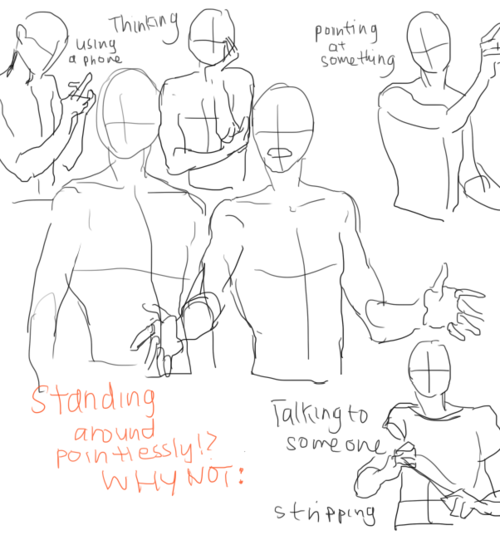
UMM for me it's easier to come up with poses if I think of my character as doing an ACTION not a pose idk if that makes sense?

So instead of thinking of a fixed pose, I think of an action that my char could be doing e.g eating a piece of pie

it's easier for me to visualize a pose if there's some context YEAH

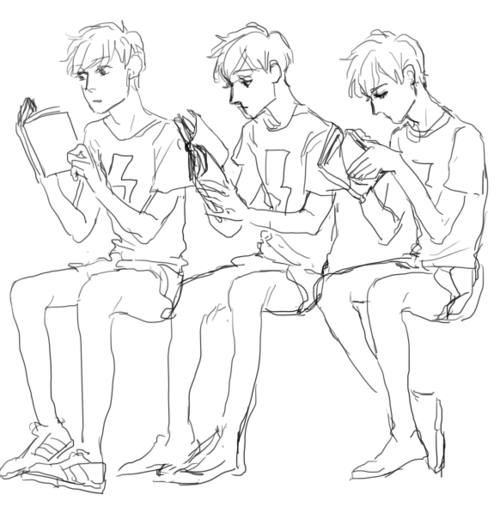
ALSO I like to draw sequences? of a certain action, and then pick the one I like best e.g. if my OC is reading


1) Standard pose > 2 & 3 poses that might follow after if this is moving 

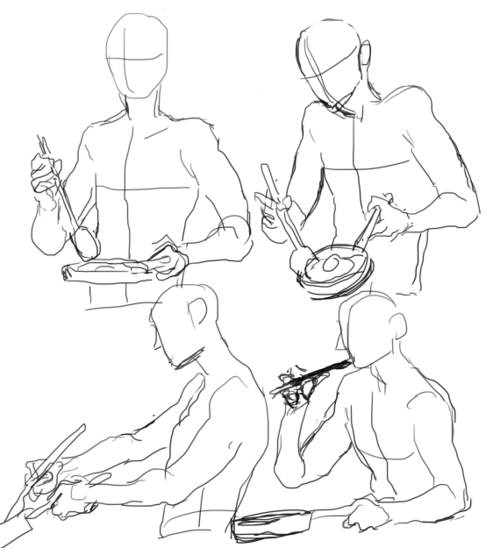
or if they're frying an egg

 I don't draw it out in full all the time ofc, sometimes I just draw like really sketchy sequences yeah idk if that makes sense, but it helps me figure out poses besides the most obvious one!

WHEN YOU DON"T KNOW where to put the hands always go back to WHAT WOULD YOU DO if you're doing this particular action?? And if all things fail, you can always go to sites like pixelovely for poses


----

Shared via my feedly reader


Battle of Five Armies 2014 [feedly]


----
Battle of Five Armies 2014
// Muddy Colors

By Justin Gerard


This is the third post on Beorne and Bolg at the Battle of the Five Armies. We are about 95% Finished!  Still a few odds and ends to tweak but it is getting to a nice stage of pleasant mayhem.


This time, instead of trying to explain how we went from here to here:


I am attaching a GIF to show the stages that the painting goes through.

I like making GIFS. Sometimes when I paint I feel like I am actually going backwards, making the piece worse minute by minute.  Seeing the actual progress of it can be really encouraging.

In the GIF you can see I am working values first before ever really getting into saturated colors.  That is because saturated colors are evil.

They are like petting a cat....

Everyone is purring and having a nice time when suddenly he whips around and tries to bite your hand off.
That is what working with saturated colors is like.


I am still working on some of the fine details, and of course my signature. (Everyone knows that the quality of one's painting is directly proportional to the size and complexity of the signature.)

After it is finished we plan to make prints of it in time to be released alongside sketchbook 2014...
Stay tuned!

For previous posts on this painting check out:

Post #1: Concept work
Post #2: The Tight Drawing


----

Shared via my feedly reader


Sent from my iPad

Going Beyond the Facts [feedly]


----
Going Beyond the Facts
// Gurney Journey

Blog reader Haden asks: "Everyone is familiar with the rule - the darkest light in the light has to be lighter than the lightest dark in the shadow. Keep the light and dark tonal ranges separate to show realistic form. But I've seen a lot of paintings when an object with a dark local value is pretty dark even though it's in the light." 


Joaquín Sorolla (1863-1923), "Sad Inheritance"


Haden continues: "Take for instance the Sorolla (painting above). The coat and the kids flesh are very different local values. According to that rule, the coat in the light should be lighter than the shadows on the kids (reflected light would be lightening their shadow sides a touch). But still the coat in the light is almost black, shouldn't it be a mid-grey?"

"If the answer is paint it as you see it, then it's not really a rule, is it? Isn't it more just a general guideline for scenes with objects similar in local value? "

Reply: Haden, you are very observant to notice that the Sorolla painting breaks the rule. I believe you are right. If this scene were actually staged outdoors in front of the sea with real people, the monk's cloak would be much lighter in the sunlight and the sea would be lighter and bluer. 

I found an alternate scan of the image which I would suppose is closer to the original, but even in this scan, the values of the cloak and the sea are still very dark.

The best answer I can give is that rules are made to be broken. The rule should be understood first, and then ignored whenever the story demands. Here, because the form of the monk is not as important as those of the children, a simple dark shape suffices. 

This is what Andrew Wyeth and other artists describe as "going beyond the facts." The painting "Sad Inheritance" is about the frailty of the human condition, the triumph of the spirit, and the gift of compassion. These are all fairly sober themes, calling for a sober palette of color and value. 


Sorolla tells a very different story in this painting of children running along the beach. It communicates pure exuberance and energy. Like the other painting, the figures are front-lit, with the sea behind them. But (assuming these scans are accurate) here the blue colors are stronger, and the foam is purer white, creating a more carefree mood. 

Sorolla's first sketch for "Sad Inheritance"
This is why it's so important to allow a composition to grow in the imagination or the memory before facing facts, regardless of whether those facts come from observation or photography. 
----


----

Shared via my feedly reader


Sent from my iPad