
Thursday, November 26, 2015

Wednesday, November 25, 2015
Tweet by CASH Music on Twitter
 | CASH Music (@cashmusic) |
Musician @johnroderick on the inherent and important value that art brings to our world archive.cashmusic.org/writing/johnro… pic.twitter.com/UduPzY4ack | |
Download the Twitter app
Sent from my iPhone
Tweet by Maria Popova on Twitter
 | Maria Popova (@brainpicker) |
Where the Wild Things really are – Maurice Sendak illustrates the Brothers Grimm fairy tales buff.ly/1YsYwLW pic.twitter.com/sVioVeSGjT | |
Download the Twitter app
Sent from my iPhone
Tuesday, November 24, 2015


Final Project: Fall Term 2015
DUE DECEMBER 7th & 8th (for respective classes)
1. Use your 18 x 24 paper
2. Use whatever materials that you wish that we have explored in class but be aware not to use this drawing as a platform for too much experimentation, use a media that you feel somewhat confident in.
3. Use one of the methods that we have gone over in class.
4. The drawing should use a foreground, middle-ground and background with an appropriate light source.
5. Base the drawing off of one you have already done in your sketchbook.
This is your opportunity to really put some time into a drawing, making it sing but be conscious that there can also be a tendency to overwork a drawing. Make sure you are communicating the subject well, that you are maintaining contrast and objectivity.
Have FUN!
1. Use your 18 x 24 paper
2. Use whatever materials that you wish that we have explored in class but be aware not to use this drawing as a platform for too much experimentation, use a media that you feel somewhat confident in.
3. Use one of the methods that we have gone over in class.
4. The drawing should use a foreground, middle-ground and background with an appropriate light source.
5. Base the drawing off of one you have already done in your sketchbook.
This is your opportunity to really put some time into a drawing, making it sing but be conscious that there can also be a tendency to overwork a drawing. Make sure you are communicating the subject well, that you are maintaining contrast and objectivity.
Have FUN!

Friday, November 20, 2015


Thursday, November 19, 2015
Wednesday, November 18, 2015
Teaching: It’s Not the Critic Who Counts [feedly]
----
Teaching: It's Not the Critic Who Counts
// Picture It
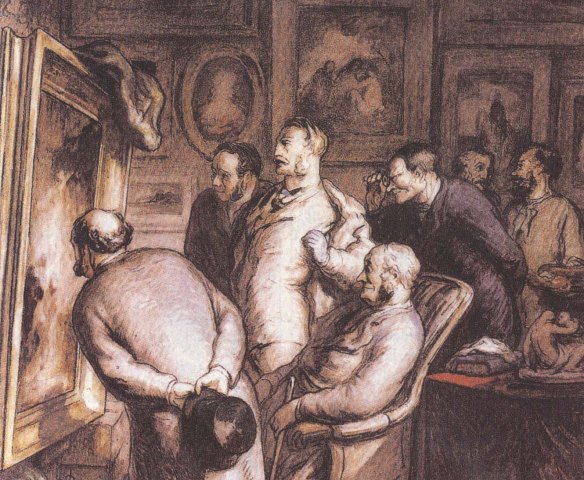
The Critics, 1862, by Honore Daumier
"It is not the critic who counts; not the man who points out how the strong man stumbles, or where the doer of deeds could have done them better. The credit belongs to the man who is actually in the arena, whose face is marred by dust and sweat and blood; who strives valiantly; who errs, who comes short again and again, because there is no effort without error and shortcoming; but who does actually strive to do the deeds; who knows great enthusiasms, the great devotions; who spends himself in a worthy cause; who at the best knows in the end the triumph of high achievement, and who at the worst, if he fails, at least fails while daring greatly, so that his place shall never be with those cold and timid souls who neither know victory nor defeat."
– Theodore Roosevelt
Every day of teaching, for me, is a risky day – a careful day. That's probably true of all teachers.
As for me, I lead critiques, which can be so helpful, yet so dangerous. Students put their homework on the wall – their personal creations – their own ideas- and face public scutiny. My job is to take it from there.
I've said many times that "crit" is not short for "criticism" – it's short for "critique". A crit should always be a learning excercise -a practice through which students learn how their work is seen through discussion with others. It's where they learn of the infinite possibilities through observation of what everyone else created. And it's where they learn how to improve through instruction and suggestion.
But, day after day, I'm reminded that critiques can be risky. Students can feel judged – and can take things personaly – no matter how many times we're advised otherwise. It's human nature.
It's a tightrope we walk in critiques. Which leads me back to the quotation above, which is new to me, and very instructive for instructors.
Always remember that what matters is the doer – the maker. They have faced the blank page. They have faced their limits. They are the ones being discussed.
It's easy to criticize, but it's trickier to critique. And the difference is everything. It's education.
Further Observation
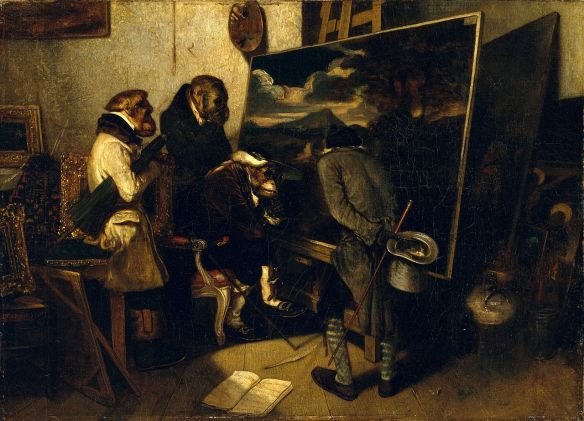
The Experts, 1837, by Alexandre-Gabriel Decamps
----
Shared via my feedly reader
Sent from my iPad
The Quest Belief System | Quest Nutrition
This is a code of ethics designed for/by a foodstuffs company but I think that most of them could be easily disguised as powerful thoughts on drawing and making things.
http://blog.questnutrition.com/the-quest-belief-system/
Sent from my iPhone
http://blog.questnutrition.com/the-quest-belief-system/
Sent from my iPhone
Blind Contour Drawings 11/18/15
Nate Marcel: greatseamonster@gmail.com: Blind Contour Drawings 11/18/15: Keys Angel Hand Violin head
We did Blind Contour studies. Here are some of mine for examples.
We did Blind Contour studies. Here are some of mine for examples.


Tuesday, November 17, 2015
Subscribe to:
Posts (Atom)