Thursday, April 5, 2018

The Robots of Mahlon Blaine


----
The Robots of Mahlon Blaine
// Black Gate
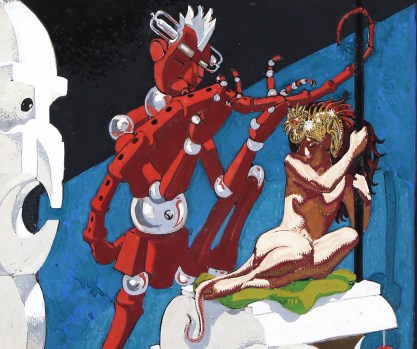
Mahlon Blaine, Cowering Nude With Robot detail

Mahlon Blaine was born in 1894 and was blind in one eye. People have been writing his biography since the 1920s and that's about all they can verify. He provided the cover art, a faceless figure carrying a sword and spear, for Sir Hugh Clifford's The Further Side of Silence. When asked for a few words about his life, he provided these:

Mahlon Blaine has illustrated these Malayan dramas with the magic of his own experience. A New England Quaker descended from staunch old New Bedford Whalers, Mahlon Blaine went to sea at fifteen and sailed before the mast in one of the last of the old wind-jammers. Then under steam he commuted from the Pacific Coast to the Atlantic, to the Mediterranean, to the Arctic to all of Kipling's Seven Seas where a merchantman seeks cargo. It is such eastern ports as Macao, Port Said, Hongkong, Pearl Harbor, that have given him his gallery of wicked, twisted Oriental faces and the museums of the world that have been his art schools. He has sailed up the Congo to make a collection of African masks, rescued fellow countrymen from jails in Indo-China, and nosed into many a Malay river for strange cargo and shipped many a Malay crew. He thinks that Sir Hugh Clifford has an uncanny knowledge of native psychology and can substantiate many of the stories by his own experiences.

Not one word is true, except possibly for the last sentence and "he."

Normally, a liar of that magnitude would be destined for pulp magazine covers but he veered into the world of high art, only occasionally dropping into our world of f&sf, most notably for the cover of Prime Press' translation of Alexandre Dumas' The Wolf Leader in 1950…
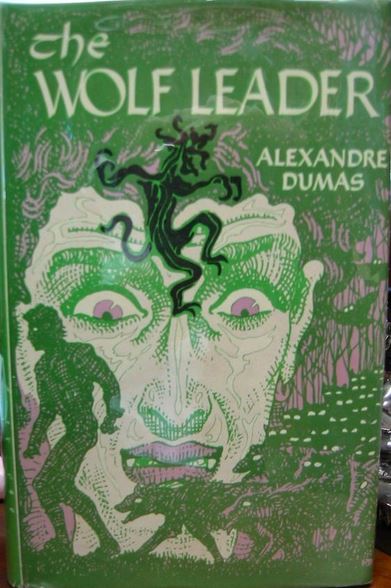
Mahlon Blaine cover of Alexander Dumas The Wolf Leader2

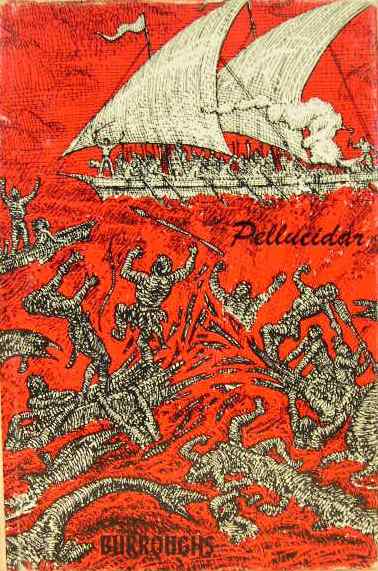
and a series of Burroughs' reprints for Canaveral Press in 1962. Canaveral didn't have to go far to seek him out. Blaine literally lived upstairs of their offices. Starving artists of the world, take note.

Mahlon Blaine cover of Burroughs The Land That Time Forgot > Mahlon Blaine cover of Burroughs Pellucidar

(Blaine also did the interior art for Here Comes Somebody in 1935, not fantasy but notable for being written by Ben Hur Lampman, whose real name was Ben Hur Lampman. I will pause the column here for you to check the veracity of that statement.)

Robots might rank eleven hundredth on a list of plausible subjects for a man with those tastes in art, but the 1930s were the decade of technological futurism invading high art and Blaine apparently got caught up in the excitement. He came to the attention of Paul R. MacAlister, an up-and-coming star of modernist interior design for the superwealthy. He was the kind of guy who not only had an office in the then-brand new and elite Rockefeller Center but "conceived and directed a display of furnishings for decorators' use known as the Permanent Exhibition of Decorative Arts and Crafts, which occupied an entire floor in the main office building."

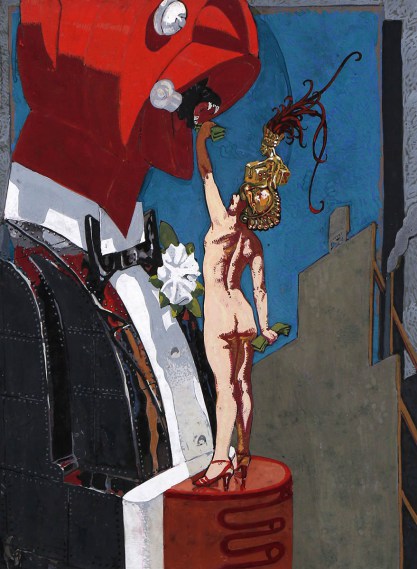
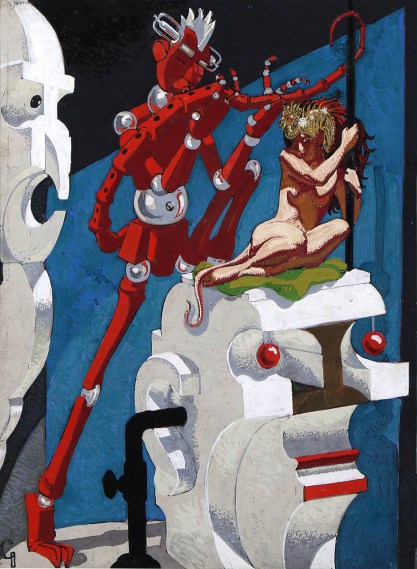
One just wasn't a somebody in the 1930s without walls covered in murals, so MacAllister commissioned Blaine for an epic set. Blaine responded with robots, and gargoyles, and nudes, in pulp terms a blend of covers from Astounding, Weird Tales, and Spicy Stories. These are three out of a total of ten original concept paintings, titled Nude Dancing with Robot, Feeding the Man, and Cowering Nude with Robot.
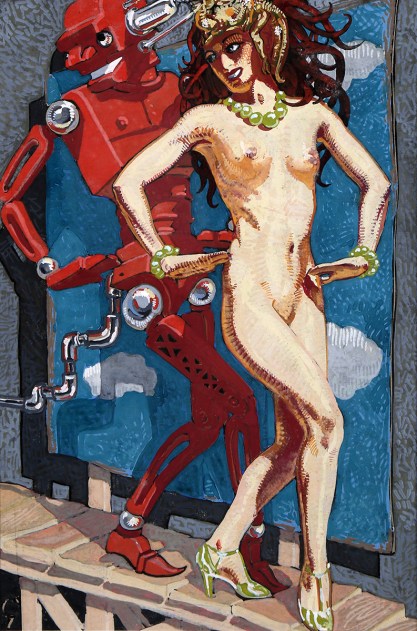
Mahlon, Blaine, Nude Dancing With Robot
Mahlon Blaine, Feeding the Man
Mahlon Blaine, Cowering Nude With Robot full

The other seven contain more nudes, mechanical birds, giant Rube Goldberg gadgets, and Daliesque imagery aplenty. Those futuristic gargoyles, already made obsolete by modern skyscrapers, would have been instant tourist attractions for anyone brave enough to attach them to a retro structure. For unknown reasons Blaine used the pseudonym G. Christopher Hudson (and signed the gouaches with a "G") and for equally unknown reasons MacAllister never went through with the project. The artwork survives and can be purchased for slightly less than a mint first edition of I, Robot. Up to you.


Steve Carper writes for The Digest Enthusiast; his story "Pity the Poor Dybbuk" appeared in Black Gate 2. His website is flyingcarsandfoodpills.com. His last article for us was Axle and Cam on the Planet Meco.


----

Read in my feedly

Tuesday, April 3, 2018

Black: The art of Gerardo Zaffino


----
Black: The art of Gerardo Zaffino
// Muddy Colors

  As I often do in my posts, I'd like to introduce the work of a fellow colleague from my city, and if you like powerful, rough inks, you're going to love Gerardo's work.   Variant cover for Rumble! – Art by Gerardo Zaffino, Colors by Dave Stewart Many of you had probably heard of him already. In the past few years he's been doing interiors for Marvel, in the "Karnak" series, and for Vertigo,…
----

Read in my feedly

Friday, March 23, 2018

Tips for Painting Lamplight


----
Tips for Painting Lamplight
// Gurney Journey


Jeff asks: "Any tips for conveying the effects of candlelight or lantern light in a painting?"

Jeff, yes, let's take a look at Viggo Johansen (1851-1935). He was a Danish painter in the Skagen group, and like his colleague Krøyer he loved to paint gatherings of friends around the dinner table. His painting Evening Talk includes a lantern on the table and two candles on the piano.

Viggo Johansen, Evening Talk, 1886
Johansen does a few things to make the effect of light convincing. 
1. The areas of dark are large and simple. Note how in the lower part of the picture, it's very hard to make out the details of the chairs and table legs.
2. The edges between forms in the outer areas are kept soft. Note the way he paints the framed canvases on the wall. They're quite blurry and out-of-focus.
3. The fall-off rate of the light roughly follows the inverse square law.
4. The effect area under the lantern is small, crisp, and detailed: lots of dots and sparkles.
5. The area of the lantern itself is a flat, warm white, with more or less glow or halation around it depending on the amount of smoke in the air.

Viggo Johansen, An Artist's Gathering, 1903
-----
Wikipedia Viggo Johansen (1851-1935)
More in my book: Color and Light: A Guide for the Realist Painter (James Gurney Art)(Amazon), or Color and Light (Signed on my website)
Previously on the blog:
Fall-Off
Candlelight
----

Read in my feedly

Wednesday, March 21, 2018

Sketching Art Materials with Pen & Wash


----
Sketching Art Materials with Pen & Wash
// will kemp art school

Morning class! This week I've been putting together a new 'Beginners Guide' for the Art School and wanted to add a few little material sketches. For all the sketches I used the following pens on 220 gsm smooth, heavyweight cartridge paper which can handle light watercolour washes. Materials – Pen & Wash Lamy Safari Fountain […]
----

Read in my feedly

Tuesday, March 20, 2018

Modern Times: Camille Paglia & Jordan B Peterson

A little intellectual but very interesting. Especially paglia's experience of modern art. I don't agree with everything said here of course.

--
-nate

Wednesday, March 14, 2018

Tuesday, March 6, 2018

Eye Candy for Today: Peter Lely trois crayon portrait


----
Eye Candy for Today: Peter Lely trois crayon portrait
// lines and colors

Peter Lely trois crayon portrait
Portrait of a Lady, Peter Lely

Black, red, and white chalk, on gray laid paper; roughly 9 1/2 x 8 inches (24 x 19 cm); in the collection of the Morgan Library and Museum, NY.

Peter Lely, known for his sumptuous and sometimes erotic portraits of royals, nobles and courtiers in the 17th century court of Charles 1, here gives us a sensitively realized portrait drawing in the "trois crayon" method.

This is a method of drawing with three chalks — black, red (sanguine) and white — on toned paper, often cream or buff, but in this case, gray. It's an approach particularly suited to figure and portrait drawing.

Though it's difficult to tell if the drawing has faded to any degree since it was done, Lely's use of white and red chalks are judicious. His application of white is just a hint of tone, subtly raising the value of areas of the face and neck and a few curls of hair.

You can tell he started the drawing of the face with the red chalk, which remains the only outline of the forehead, lower face and nose, though the eyes and brows have been reinforced with black.

I haven't been through the hundreds of portraits attributed to Lely and his very active workshop in enough detail to know if this was a preliminary for a finished painting, but Lely evidently thought enough of the drawing that he signed it.


----

Read in my feedly


Sent from my iPhone

Saturday, March 3, 2018

Is snacking learning?


----
Is snacking learning?
// Seth Godin's Blog on marketing, tribes and respect

Why does a class last an hour? Why does a TED talk last 18 minutes? Why does an MBA take two years?

Could it be that the default lesson length has something to do with the cost of switching rooms, which makes it inefficient to have really short lessons? Or the high cost of physical space, which makes it expensive to have really long ones... Perhaps length is a function of switching costs and bureaucracy structure...

One side effect of the low switching costs and high availability of choice on the web is that people are discovering things in 600-second bursts. 

What would happen if we started to do this on purpose? Learn a math lesson, understand a social history movement, learn something about human nature, five minutes have gone by...

Or what if we chose to dive in really deep, deeper than the real world would ordinarily tolerate. Five hours on a topic that might only get three minutes on a typical curriculum... or a month-long interactive seminar designed to teach something that's almost never taught.

I don't think learning is defined by a building or a certificate. It's defined by a posture, a mindset and actions taken.

It's still early days in figuring out the best way to transfer knowledge. The length of a class ought not to be set in stone. (For the very same reason that meetings at work should never last an hour).


----

Read in my feedly


Sent from my iPhone

FZD Term 1 - Fundamentals


----
FZD Term 1 - Fundamentals
// Feng Zhu Design

I'll continue sharing the courses we teach at FZD School of Design.

Besides Design Sketching, Term 1 also covers Perspective and Visual Communications 1.

All objects, whether soft surface (creatures, humans, etc.), or hard surface (vehicles, buildings, props, etc.), exist in 3D space. Thus, students must first understand how to "think" and "see" in 3D. By knowing how to calculate forms in perspective, students are able to design almost any subject matter. All possibilities are opened up once they understand how to use fundamentals. Students are no longer limited by themes or familiarity. They can tackle new subject matters and pickup design languages quickly.

Our perspective course cover the overall concept. Students are also introduced to 3D software during this term (more on this later).

Vis Comm 1 cover the concept of "draw through." This is a drawing technique in which objects are plotted out in 3D space. Basically, you draw what is actually there, verses just drawing what you see. This is a very time consuming process to learn, but it is one of the most important tools in my opinion. All objects are drawn in 3/4 product view.

So why not just use 3D software directly? Why even bother learning perspective when the tools can do it for you? The answer is simple. Photoshop and 3D software are just tools. They can't help you design. Tools are use to assist the designer, not the other way around. This is why we only introduce 3D software half way into a term.

For more examples, please visit : FZDSCHOOL.COM


----

Read in my feedly


Sent from my iPhone

Friday, March 2, 2018

Words of Wisdom


----
Words of Wisdom
// Deja View

...from Don Graham, Disney's prime art teacher during the Golden Age of animation. All of the animators valued his classes enormously. This is a magazine article from December of 1940.


----

Read in my feedly


Sent from my iPhone